
Summary
Discreet jewelry shipping requires a coordinated process that protects the contents, limits unnecessary exposure, and maintains clear shipment records. Before sending jewelry, shippers should verify insurance eligibility, understand coverage limits and exclusions, prepare accurate documentation, use suitable internal and external packaging, and arrange an appropriate delivery method. This guide explains the practical steps involved in insured jewelry shipping Dallas and how UNIVAL Logistics can help customers plan shipments with care and attention to detail.
Overview
Jewelry shipments can involve engagement rings, luxury watches, precious stones, necklaces, bracelets, earrings, and valuable business inventory. Their compact size and high value make them particularly important to prepare carefully. A package may look ordinary from the outside, but its contents still require suitable protection, accurate records, and a shipping arrangement that meets the requirements of the selected insurance provider.
A successful shipment starts before the package is handed to a carrier. The sender must confirm that the item is eligible for coverage, determine the appropriate insured value, review packaging rules, and understand the delivery and claim procedures. UNIVAL Logistics helps customers consider these important requirements when arranging secure shipping services in Dallas.
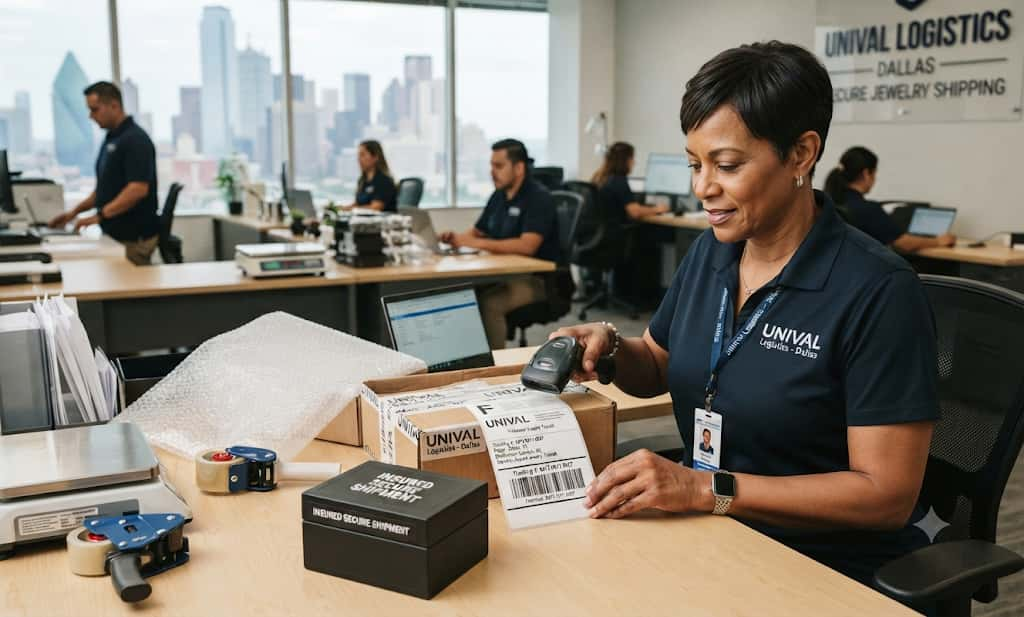
Key Takeaways
Why Discreet and Insured Jewelry Shipping Requires Careful Planning
Jewelry is often small enough to fit into a compact parcel, but its value can be substantial. A ring, gemstone, luxury watch, or collection of precious metal pieces may require more attention than an ordinary package. If packaging is weak, documentation is incomplete, or insurance conditions are misunderstood, the sender may face avoidable complications.
Discretion is also an important consideration. Packaging that reveals the contents or advertises the value of the shipment can attract unnecessary attention. A professional shipping process should protect the contents while limiting the amount of information visible to people who do not need it.
For businesses such as jewelers, jewelry retailers, repair specialists, and wholesalers, consistent shipping procedures can also support customer confidence. Each parcel should be prepared according to the item's characteristics, insurance requirements, and delivery needs.
The Complete Insured Jewelry Shipping Dallas Checklist
The following checklist covers the main steps to consider before, during, and after dispatch. Requirements can differ according to the carrier, insurance provider, shipment route, item type, and declared value. Always confirm the applicable terms before sending valuable jewelry.
1. Identify and Inspect Every Jewelry Item
Begin by identifying exactly what you intend to ship. Do not rely on a general description such as "jewelry" when preparing your internal records or insurance information. Record the item type, material, quantity, and any distinguishing characteristics.
For example, a shipment might contain a gold necklace, a diamond engagement ring, or a luxury wristwatch. Each item may have different valuation and coverage requirements.
Before packing, inspect the item for existing damage, loose settings, scratches, missing stones, or other visible issues. Make a written condition record and take clear photographs from multiple angles. These records can help establish the item's condition before dispatch if a loss or damage claim becomes necessary.
For multiple items, create an itemized inventory. Assign each piece a reference number so that photographs, invoices, appraisals, and packing records can be matched accurately.
2. Verify Insurance Eligibility Before Dispatch
Insurance should never be assumed simply because a shipment has a tracking number or a declared value. The sender must confirm that the selected coverage specifically applies to the jewelry being shipped.
Some shipping arrangements may restrict particular categories, including loose gemstones, precious metals, watches, antique jewelry, or items above a specified value. Other policies may require special packaging, approved shipping methods, additional documentation, or specific security procedures.
Before choosing a service, ask the provider to clarify:
3. Establish an Accurate and Supportable Jewelry Value
The value entered in shipping or insurance documentation should be accurate and supported by suitable records. An unsupported estimate can create problems if the shipment is lost or damaged.
Depending on the item and policy requirements, supporting documents may include a recent purchase invoice, professional appraisal, sales record, repair valuation, or other accepted proof of value. For pre-owned jewelry, the appropriate valuation method may differ from the original retail price.
Keep copies of all supporting records in a secure location. Avoid placing unnecessary financial documents inside the parcel unless the carrier or insurance provider specifically requires them. Share sensitive information only through the approved process.
It is also important to distinguish between a carrier's declared-value service and an insurance policy. These arrangements may have different terms, limits, exclusions, and claim procedures. Ask for clarification rather than assuming they provide identical protection.
4. Choose Discreet Outer Packaging
Discreet packaging helps avoid drawing attention to valuable contents. The outer package should not advertise the presence of diamonds, gold, luxury watches, or expensive jewelry.
Use clean, sturdy packaging that does not reveal the contents through transparent sections, product branding, or unnecessary descriptions. Avoid labels, decorative marks, or wording that identifies the parcel as a high-value jewelry shipment.
Discretion does not mean concealing required shipping information. The parcel must still display accurate carrier labels, legally required declarations, and any documentation needed for transportation or customs clearance. The goal is to limit unnecessary exposure while maintaining full compliance with shipping requirements.
5. Secure the Jewelry Inside the Package
Internal protection is just as important as the outer packaging. Jewelry should be secured so that it cannot move freely, become tangled, scratch another item, or be damaged by impact.
Use suitable protective materials based on the item's size, shape, and fragility. Individual jewelry pieces should generally be separated and secured. Small components, such as earrings or loose parts, should be contained so they cannot shift during transit.
For valuable or delicate pieces, consider the following preparation steps:
6. Confirm Packaging Rules With the Insurance Provider
Some insurance arrangements require specific packaging standards or approved shipping procedures. A package that appears secure may still fail to meet the conditions of a particular policy.
Check whether the provider specifies approved packaging materials, tamper-evident seals, double-boxing, particular closure methods, or restrictions on reused containers. Follow the written instructions and retain evidence of compliance where practical.
If the shipment contains several high-value pieces, ask whether they should be packed together or sent separately. The appropriate approach depends on the coverage terms, risk assessment, and shipping arrangement.
7. Prepare Accurate Shipping and Inventory Documentation
Documentation helps establish what was shipped, who sent it, who should receive it, and what records support the shipment's value.
Prepare an internal shipping record that includes the item description, quantity, reference numbers, condition photographs, supporting valuation documents, and dispatch date. Keep the carrier receipt and tracking information with the same shipment file.
The shipping label and any required declarations must contain accurate information. Do not misdescribe the contents or provide false values to avoid attention, fees, or shipping restrictions. Inaccurate declarations can affect service eligibility, customs processing, and insurance claims.
For business shipments, a consistent documentation process can make it easier to reconcile outgoing inventory, customer orders, repairs, and returns.
8. Select an Appropriate Shipping and Insurance Arrangement
Not every shipping service is suitable for every jewelry shipment. Compare the available options based on the item's value, destination, delivery timeline, insurance terms, tracking capabilities, handling requirements, and recipient arrangements.
Before confirming a service, understand the difference between:
Standard parcel shipping: A general delivery service that may provide tracking but may not offer the level of coverage required for valuable jewelry.
Declared-value services: Services that record a shipment value under the carrier's terms. A declared value should not automatically be treated as equivalent to comprehensive insurance.
Specialized insured shipping arrangements: Services designed to accommodate eligible high-value shipments under specific coverage, handling, and documentation conditions.
The right choice depends on the complete terms, not just the advertised coverage amount or delivery speed. UNIVAL Logistics can help customers discuss their shipping requirements and identify the questions to resolve before dispatch.
9. Use Tracking and Maintain Shipment Visibility
Tracking provides shipment visibility and creates a record of important transit events. Save the tracking number immediately after dispatch and monitor the shipment through the carrier's approved tracking system.
Check for unexpected delays, delivery exceptions, address issues, or unsuccessful delivery attempts. If tracking information stops updating or indicates a problem, contact the responsible shipping provider promptly and keep a record of the communication.
Tracking is useful, but it is not a substitute for insurance. It may show where a parcel was last scanned without proving the exact condition of its contents. Maintain both tracking records and the separate documents required by the insurance arrangement.
10. Arrange Controlled Delivery and Recipient Verification
The delivery stage deserves the same attention as packaging and dispatch. A valuable jewelry parcel should be sent to a verified address with delivery instructions that meet the carrier's and insurer's requirements.
Where available and appropriate, consider delivery options such as signature confirmation, named-recipient delivery, or other approved verification procedures. Confirm who is authorized to receive the parcel, especially when shipping to a business, showroom, repair facility, or commercial premises.
Avoid leaving valuable shipments unattended unless the shipping and insurance terms expressly permit that arrangement. The recipient should inspect the parcel promptly and report visible damage, tampering, or delivery discrepancies according to the provider's procedure.
11. Record Every Important Handover
A clear handover record supports accountability. Businesses that regularly send jewelry should maintain a consistent process for recording when a parcel is packed, sealed, collected, transferred, and received.
Depending on the service arrangement, relevant records may include collection receipts, shipment scans, seal references, authorized staff details, and recipient confirmation. Keep these records together so they can be retrieved quickly if a shipment issue occurs.
For valuable business inventory, documented handovers can also help identify where a discrepancy arose and which party should be contacted.
12. Prepare for a Potential Insurance Claim
Even with careful preparation, shipments can encounter unexpected problems. Knowing the claim process before dispatch can save time if a parcel is lost, damaged, or delivered with signs of tampering.
Review the policy's notification deadlines, evidence requirements, claim submission process, and any inspection instructions. If an issue occurs, notify the carrier or insurance provider promptly and follow its instructions.
Depending on the circumstances, the provider may request:
How to Maintain Discretion Throughout the Shipping Process
Discretion should be considered at every stage rather than only when selecting the outer box. A secure process limits unnecessary access to shipment information while preserving the records needed for transportation and insurance.
Limit Access to Shipment Information
Only employees or authorized individuals who need shipment details should have access to them. Avoid sharing item values, photographs, recipient details, or tracking information through unsecured channels.
For businesses, establish a simple internal procedure that identifies who can approve a shipment, prepare the package, arrange collection, and confirm delivery. This helps reduce confusion and unnecessary disclosure.
Avoid Unnecessary Packaging Details
Use neutral external packaging where permitted. Product names, luxury branding, and descriptions that reveal the contents should not appear unnecessarily on the outside of the parcel.
However, all mandatory declarations and carrier instructions must remain accurate. Discretion must never involve misleading a carrier, insurer, customs authority, or recipient.
Keep Internal Records Secure
Invoices, appraisals, customer information, and inventory records can contain commercially sensitive details. Store them in an access-controlled system and share them only with the parties who require them for shipping, insurance, compliance, or claims handling.
A well-organized recordkeeping process supports both privacy and accountability.
Common Mistakes to Avoid When Shipping Jewelry
Even a carefully packed parcel can face problems when important shipping requirements are overlooked. Some of the most common mistakes include assuming that a tracking number provides insurance, declaring a value without supporting documents, and failing to check whether the policy covers the specific jewelry category.
Other avoidable errors include using weak packaging, allowing items to move inside the box, leaving valuable parcels unattended, and missing claim notification deadlines. Businesses may also experience difficulties when different employees use inconsistent packing or handover procedures.
A practical checklist reduces these risks by making each step repeatable. Before dispatch, confirm that the item is eligible, its value is documented, packaging requirements are met, and the delivery process is understood.
How UNIVAL Logistics Supports Jewelry Shipping in Dallas
Shipping valuable jewelry requires careful coordination between packaging, documentation, insurance requirements, tracking, and delivery arrangements. UNIVAL Logistics helps customers consider these requirements when planning high-value shipments.
Whether you are a jewelry retailer, wholesaler, repair specialist, or individual sender, it is important to understand the service conditions before handing over valuable items. UNIVAL Logistics can help you discuss shipment details, identify documentation requirements, and review the practical considerations involved in arranging suitable shipping services.
Customers should provide accurate information about the jewelry category, approximate value, packaging needs, destination, and preferred delivery arrangements. This helps determine which service options may be appropriate and what additional requirements need to be confirmed.
For insured jewelry shipping Dallas, the most useful approach is to plan the shipment before packing begins. Confirming eligibility, coverage conditions, and handling requirements early can help prevent avoidable delays and misunderstandings.
Final Pre-Dispatch Checklist
Before handing over a jewelry shipment, review these essential points:
Conclusion: Ship Valuable Jewelry With Greater Confidence
Discreet jewelry shipping depends on preparation, suitable packaging, accurate documentation, and a clear understanding of insurance conditions. No single measure can eliminate every shipping risk, but a consistent process can help protect valuable items and make shipment issues easier to investigate.
For businesses and individuals arranging jewelry deliveries in Dallas, reviewing the service and insurance terms before dispatch is essential. UNIVAL Logistics can help customers discuss their shipping needs and consider practical arrangements for valuable shipments.
Choose a shipping process that prioritizes discretion, accountability, and appropriate protection. Contact UNIVAL Logistics to discuss your jewelry shipping requirements and plan your next shipment with care.
Frequently Asked Questions
1. What is insured jewelry shipping in Dallas?
Insured jewelry shipping is a shipping arrangement in which eligible jewelry is transported under specified insurance or coverage terms. The actual protection depends on the provider, policy limits, exclusions, shipment value, and compliance with required procedures.
2. How should I pack jewelry for discreet shipping?
Place each jewelry item in suitable protective packaging, prevent movement inside the container, and use a strong outer box that does not unnecessarily reveal the contents. Follow any additional packaging requirements specified by the carrier or insurance provider.
3. Does a declared value mean my jewelry is fully insured?
Not necessarily. Declared value and insurance can operate under different terms. Confirm whether the selected service provides insurance, what losses are covered, and whether the full value is eligible for protection.
4. What documents are needed to ship valuable jewelry?
Depending on the shipment and provider, useful records may include purchase invoices, appraisals, itemized inventories, condition photographs, shipping receipts, and tracking information. International shipments may also require customs declarations and additional supporting documents.
5. Can engagement rings and diamond jewelry be shipped with insurance?
Some shipping and insurance arrangements accept engagement rings and diamond jewelry, while others may impose category restrictions, value limits, or special conditions. Confirm eligibility for the exact item before dispatch.
6. Is tracking enough to protect a valuable jewelry shipment?
No. Tracking helps monitor shipment progress, but it does not automatically provide insurance or guarantee reimbursement for loss or damage. Review the coverage terms separately and retain all required shipment records.
7. Why is discreet packaging important for jewelry shipments?
Discreet packaging avoids unnecessarily identifying valuable contents to people who do not need that information. It should still include accurate shipping labels and all legally or operationally required declarations.
8. What should I do if my jewelry shipment is lost or damaged?
Contact the carrier and insurance provider promptly, follow their reporting instructions, and preserve the packaging and shipment records. You may need to provide proof of value, pre-shipment photographs, tracking details, and evidence of the damage or loss.
9. How can businesses improve jewelry shipping procedures?
Businesses can establish standardized packing instructions, maintain itemized inventories, restrict access to shipment information, document handovers, and train staff to follow insurance and delivery requirements consistently.
10. How can UNIVAL Logistics help with jewelry shipping in Dallas?
UNIVAL Logistics can help customers discuss valuable shipment requirements, including packaging considerations, documentation, insurance conditions, tracking, and delivery coordination. Contact the team to review the needs of your shipment and confirm the available service options.
Discreet jewelry shipping requires a coordinated process that protects the contents, limits unnecessary exposure, and maintains clear shipment records. Before sending jewelry, shippers should verify insurance eligibility, understand coverage limits and exclusions, prepare accurate documentation, use suitable internal and external packaging, and arrange an appropriate delivery method. This guide explains the practical steps involved in insured jewelry shipping Dallas and how UNIVAL Logistics can help customers plan shipments with care and attention to detail.
Overview
Jewelry shipments can involve engagement rings, luxury watches, precious stones, necklaces, bracelets, earrings, and valuable business inventory. Their compact size and high value make them particularly important to prepare carefully. A package may look ordinary from the outside, but its contents still require suitable protection, accurate records, and a shipping arrangement that meets the requirements of the selected insurance provider.
A successful shipment starts before the package is handed to a carrier. The sender must confirm that the item is eligible for coverage, determine the appropriate insured value, review packaging rules, and understand the delivery and claim procedures. UNIVAL Logistics helps customers consider these important requirements when arranging secure shipping services in Dallas.
Key Takeaways
- Confirm that the jewelry type and shipment value are eligible for insurance coverage.
- Review policy limits, exclusions, deductibles, and claim requirements before shipping.
- Use discreet outer packaging and secure internal protection.
- Photograph and document the jewelry before packing.
- Keep shipment receipts, tracking details, and insurance records.
- Use a delivery arrangement with appropriate tracking and recipient verification.
- Maintain clear records of every important shipment handover.
- Contact UNIVAL Logistics to discuss suitable shipping arrangements for valuable jewelry.
Why Discreet and Insured Jewelry Shipping Requires Careful Planning
Jewelry is often small enough to fit into a compact parcel, but its value can be substantial. A ring, gemstone, luxury watch, or collection of precious metal pieces may require more attention than an ordinary package. If packaging is weak, documentation is incomplete, or insurance conditions are misunderstood, the sender may face avoidable complications.
Discretion is also an important consideration. Packaging that reveals the contents or advertises the value of the shipment can attract unnecessary attention. A professional shipping process should protect the contents while limiting the amount of information visible to people who do not need it.
For businesses such as jewelers, jewelry retailers, repair specialists, and wholesalers, consistent shipping procedures can also support customer confidence. Each parcel should be prepared according to the item's characteristics, insurance requirements, and delivery needs.
The Complete Insured Jewelry Shipping Dallas Checklist
The following checklist covers the main steps to consider before, during, and after dispatch. Requirements can differ according to the carrier, insurance provider, shipment route, item type, and declared value. Always confirm the applicable terms before sending valuable jewelry.
1. Identify and Inspect Every Jewelry Item
Begin by identifying exactly what you intend to ship. Do not rely on a general description such as "jewelry" when preparing your internal records or insurance information. Record the item type, material, quantity, and any distinguishing characteristics.
For example, a shipment might contain a gold necklace, a diamond engagement ring, or a luxury wristwatch. Each item may have different valuation and coverage requirements.
Before packing, inspect the item for existing damage, loose settings, scratches, missing stones, or other visible issues. Make a written condition record and take clear photographs from multiple angles. These records can help establish the item's condition before dispatch if a loss or damage claim becomes necessary.
For multiple items, create an itemized inventory. Assign each piece a reference number so that photographs, invoices, appraisals, and packing records can be matched accurately.
2. Verify Insurance Eligibility Before Dispatch
Insurance should never be assumed simply because a shipment has a tracking number or a declared value. The sender must confirm that the selected coverage specifically applies to the jewelry being shipped.
Some shipping arrangements may restrict particular categories, including loose gemstones, precious metals, watches, antique jewelry, or items above a specified value. Other policies may require special packaging, approved shipping methods, additional documentation, or specific security procedures.
Before choosing a service, ask the provider to clarify:
- Whether the exact jewelry category is eligible for coverage.
- The maximum permitted insured or declared value.
- Whether coverage applies during collection, transit, and final delivery.
- Whether theft, loss, and physical damage are covered.
- Which packaging and handover procedures must be followed.
- What evidence is required if a claim is submitted.
3. Establish an Accurate and Supportable Jewelry Value
The value entered in shipping or insurance documentation should be accurate and supported by suitable records. An unsupported estimate can create problems if the shipment is lost or damaged.
Depending on the item and policy requirements, supporting documents may include a recent purchase invoice, professional appraisal, sales record, repair valuation, or other accepted proof of value. For pre-owned jewelry, the appropriate valuation method may differ from the original retail price.
Keep copies of all supporting records in a secure location. Avoid placing unnecessary financial documents inside the parcel unless the carrier or insurance provider specifically requires them. Share sensitive information only through the approved process.
It is also important to distinguish between a carrier's declared-value service and an insurance policy. These arrangements may have different terms, limits, exclusions, and claim procedures. Ask for clarification rather than assuming they provide identical protection.
4. Choose Discreet Outer Packaging
Discreet packaging helps avoid drawing attention to valuable contents. The outer package should not advertise the presence of diamonds, gold, luxury watches, or expensive jewelry.
Use clean, sturdy packaging that does not reveal the contents through transparent sections, product branding, or unnecessary descriptions. Avoid labels, decorative marks, or wording that identifies the parcel as a high-value jewelry shipment.
Discretion does not mean concealing required shipping information. The parcel must still display accurate carrier labels, legally required declarations, and any documentation needed for transportation or customs clearance. The goal is to limit unnecessary exposure while maintaining full compliance with shipping requirements.
5. Secure the Jewelry Inside the Package
Internal protection is just as important as the outer packaging. Jewelry should be secured so that it cannot move freely, become tangled, scratch another item, or be damaged by impact.
Use suitable protective materials based on the item's size, shape, and fragility. Individual jewelry pieces should generally be separated and secured. Small components, such as earrings or loose parts, should be contained so they cannot shift during transit.
For valuable or delicate pieces, consider the following preparation steps:
- Place each item in an appropriate protective pouch, box, or compartment.
- Prevent movement inside the inner container.
- Use cushioning suitable for the item's weight and fragility.
- Secure the inner package within a strong outer shipping container.
- Check that the package remains closed and stable when gently handled.
6. Confirm Packaging Rules With the Insurance Provider
Some insurance arrangements require specific packaging standards or approved shipping procedures. A package that appears secure may still fail to meet the conditions of a particular policy.
Check whether the provider specifies approved packaging materials, tamper-evident seals, double-boxing, particular closure methods, or restrictions on reused containers. Follow the written instructions and retain evidence of compliance where practical.
If the shipment contains several high-value pieces, ask whether they should be packed together or sent separately. The appropriate approach depends on the coverage terms, risk assessment, and shipping arrangement.
7. Prepare Accurate Shipping and Inventory Documentation
Documentation helps establish what was shipped, who sent it, who should receive it, and what records support the shipment's value.
Prepare an internal shipping record that includes the item description, quantity, reference numbers, condition photographs, supporting valuation documents, and dispatch date. Keep the carrier receipt and tracking information with the same shipment file.
The shipping label and any required declarations must contain accurate information. Do not misdescribe the contents or provide false values to avoid attention, fees, or shipping restrictions. Inaccurate declarations can affect service eligibility, customs processing, and insurance claims.
For business shipments, a consistent documentation process can make it easier to reconcile outgoing inventory, customer orders, repairs, and returns.
8. Select an Appropriate Shipping and Insurance Arrangement
Not every shipping service is suitable for every jewelry shipment. Compare the available options based on the item's value, destination, delivery timeline, insurance terms, tracking capabilities, handling requirements, and recipient arrangements.
Before confirming a service, understand the difference between:
Standard parcel shipping: A general delivery service that may provide tracking but may not offer the level of coverage required for valuable jewelry.
Declared-value services: Services that record a shipment value under the carrier's terms. A declared value should not automatically be treated as equivalent to comprehensive insurance.
Specialized insured shipping arrangements: Services designed to accommodate eligible high-value shipments under specific coverage, handling, and documentation conditions.
The right choice depends on the complete terms, not just the advertised coverage amount or delivery speed. UNIVAL Logistics can help customers discuss their shipping requirements and identify the questions to resolve before dispatch.
9. Use Tracking and Maintain Shipment Visibility
Tracking provides shipment visibility and creates a record of important transit events. Save the tracking number immediately after dispatch and monitor the shipment through the carrier's approved tracking system.
Check for unexpected delays, delivery exceptions, address issues, or unsuccessful delivery attempts. If tracking information stops updating or indicates a problem, contact the responsible shipping provider promptly and keep a record of the communication.
Tracking is useful, but it is not a substitute for insurance. It may show where a parcel was last scanned without proving the exact condition of its contents. Maintain both tracking records and the separate documents required by the insurance arrangement.
10. Arrange Controlled Delivery and Recipient Verification
The delivery stage deserves the same attention as packaging and dispatch. A valuable jewelry parcel should be sent to a verified address with delivery instructions that meet the carrier's and insurer's requirements.
Where available and appropriate, consider delivery options such as signature confirmation, named-recipient delivery, or other approved verification procedures. Confirm who is authorized to receive the parcel, especially when shipping to a business, showroom, repair facility, or commercial premises.
Avoid leaving valuable shipments unattended unless the shipping and insurance terms expressly permit that arrangement. The recipient should inspect the parcel promptly and report visible damage, tampering, or delivery discrepancies according to the provider's procedure.
11. Record Every Important Handover
A clear handover record supports accountability. Businesses that regularly send jewelry should maintain a consistent process for recording when a parcel is packed, sealed, collected, transferred, and received.
Depending on the service arrangement, relevant records may include collection receipts, shipment scans, seal references, authorized staff details, and recipient confirmation. Keep these records together so they can be retrieved quickly if a shipment issue occurs.
For valuable business inventory, documented handovers can also help identify where a discrepancy arose and which party should be contacted.
12. Prepare for a Potential Insurance Claim
Even with careful preparation, shipments can encounter unexpected problems. Knowing the claim process before dispatch can save time if a parcel is lost, damaged, or delivered with signs of tampering.
Review the policy's notification deadlines, evidence requirements, claim submission process, and any inspection instructions. If an issue occurs, notify the carrier or insurance provider promptly and follow its instructions.
Depending on the circumstances, the provider may request:
- The original shipping receipt and tracking information.
- Proof of the jewelry's value and ownership.
- Pre-shipment photographs and condition records.
- Photographs of the outer packaging and any damage.
- Delivery confirmation or records of a failed delivery.
- Relevant correspondence and incident details.
How to Maintain Discretion Throughout the Shipping Process
Discretion should be considered at every stage rather than only when selecting the outer box. A secure process limits unnecessary access to shipment information while preserving the records needed for transportation and insurance.
Limit Access to Shipment Information
Only employees or authorized individuals who need shipment details should have access to them. Avoid sharing item values, photographs, recipient details, or tracking information through unsecured channels.
For businesses, establish a simple internal procedure that identifies who can approve a shipment, prepare the package, arrange collection, and confirm delivery. This helps reduce confusion and unnecessary disclosure.
Avoid Unnecessary Packaging Details
Use neutral external packaging where permitted. Product names, luxury branding, and descriptions that reveal the contents should not appear unnecessarily on the outside of the parcel.
However, all mandatory declarations and carrier instructions must remain accurate. Discretion must never involve misleading a carrier, insurer, customs authority, or recipient.
Keep Internal Records Secure
Invoices, appraisals, customer information, and inventory records can contain commercially sensitive details. Store them in an access-controlled system and share them only with the parties who require them for shipping, insurance, compliance, or claims handling.
A well-organized recordkeeping process supports both privacy and accountability.
Common Mistakes to Avoid When Shipping Jewelry
Even a carefully packed parcel can face problems when important shipping requirements are overlooked. Some of the most common mistakes include assuming that a tracking number provides insurance, declaring a value without supporting documents, and failing to check whether the policy covers the specific jewelry category.
Other avoidable errors include using weak packaging, allowing items to move inside the box, leaving valuable parcels unattended, and missing claim notification deadlines. Businesses may also experience difficulties when different employees use inconsistent packing or handover procedures.
A practical checklist reduces these risks by making each step repeatable. Before dispatch, confirm that the item is eligible, its value is documented, packaging requirements are met, and the delivery process is understood.
How UNIVAL Logistics Supports Jewelry Shipping in Dallas
Shipping valuable jewelry requires careful coordination between packaging, documentation, insurance requirements, tracking, and delivery arrangements. UNIVAL Logistics helps customers consider these requirements when planning high-value shipments.
Whether you are a jewelry retailer, wholesaler, repair specialist, or individual sender, it is important to understand the service conditions before handing over valuable items. UNIVAL Logistics can help you discuss shipment details, identify documentation requirements, and review the practical considerations involved in arranging suitable shipping services.
Customers should provide accurate information about the jewelry category, approximate value, packaging needs, destination, and preferred delivery arrangements. This helps determine which service options may be appropriate and what additional requirements need to be confirmed.
For insured jewelry shipping Dallas, the most useful approach is to plan the shipment before packing begins. Confirming eligibility, coverage conditions, and handling requirements early can help prevent avoidable delays and misunderstandings.
Final Pre-Dispatch Checklist
Before handing over a jewelry shipment, review these essential points:
- The jewelry has been identified and inspected.
- Clear photographs and an itemized inventory have been prepared.
- The item's value is supported by suitable documentation.
- The insurance provider has confirmed eligibility.
- Coverage limits, exclusions, and claim conditions have been reviewed.
- The inner packaging protects each item from movement and damage.
- The outer packaging is sturdy and discreet.
- All shipping labels and required declarations are accurate.
- The delivery address and authorized recipient have been verified.
- Tracking, collection, and handover records will be retained.
- The claim notification process and deadlines are understood.
Conclusion: Ship Valuable Jewelry With Greater Confidence
Discreet jewelry shipping depends on preparation, suitable packaging, accurate documentation, and a clear understanding of insurance conditions. No single measure can eliminate every shipping risk, but a consistent process can help protect valuable items and make shipment issues easier to investigate.
For businesses and individuals arranging jewelry deliveries in Dallas, reviewing the service and insurance terms before dispatch is essential. UNIVAL Logistics can help customers discuss their shipping needs and consider practical arrangements for valuable shipments.
Choose a shipping process that prioritizes discretion, accountability, and appropriate protection. Contact UNIVAL Logistics to discuss your jewelry shipping requirements and plan your next shipment with care.
Frequently Asked Questions
1. What is insured jewelry shipping in Dallas?
Insured jewelry shipping is a shipping arrangement in which eligible jewelry is transported under specified insurance or coverage terms. The actual protection depends on the provider, policy limits, exclusions, shipment value, and compliance with required procedures.
2. How should I pack jewelry for discreet shipping?
Place each jewelry item in suitable protective packaging, prevent movement inside the container, and use a strong outer box that does not unnecessarily reveal the contents. Follow any additional packaging requirements specified by the carrier or insurance provider.
3. Does a declared value mean my jewelry is fully insured?
Not necessarily. Declared value and insurance can operate under different terms. Confirm whether the selected service provides insurance, what losses are covered, and whether the full value is eligible for protection.
4. What documents are needed to ship valuable jewelry?
Depending on the shipment and provider, useful records may include purchase invoices, appraisals, itemized inventories, condition photographs, shipping receipts, and tracking information. International shipments may also require customs declarations and additional supporting documents.
5. Can engagement rings and diamond jewelry be shipped with insurance?
Some shipping and insurance arrangements accept engagement rings and diamond jewelry, while others may impose category restrictions, value limits, or special conditions. Confirm eligibility for the exact item before dispatch.
6. Is tracking enough to protect a valuable jewelry shipment?
No. Tracking helps monitor shipment progress, but it does not automatically provide insurance or guarantee reimbursement for loss or damage. Review the coverage terms separately and retain all required shipment records.
7. Why is discreet packaging important for jewelry shipments?
Discreet packaging avoids unnecessarily identifying valuable contents to people who do not need that information. It should still include accurate shipping labels and all legally or operationally required declarations.
8. What should I do if my jewelry shipment is lost or damaged?
Contact the carrier and insurance provider promptly, follow their reporting instructions, and preserve the packaging and shipment records. You may need to provide proof of value, pre-shipment photographs, tracking details, and evidence of the damage or loss.
9. How can businesses improve jewelry shipping procedures?
Businesses can establish standardized packing instructions, maintain itemized inventories, restrict access to shipment information, document handovers, and train staff to follow insurance and delivery requirements consistently.
10. How can UNIVAL Logistics help with jewelry shipping in Dallas?
UNIVAL Logistics can help customers discuss valuable shipment requirements, including packaging considerations, documentation, insurance conditions, tracking, and delivery coordination. Contact the team to review the needs of your shipment and confirm the available service options.